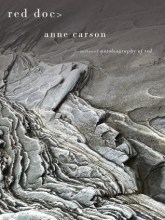
 nne Carson. Red Doc>. The sequel to Autobiography of Red. It doesn’t often happen that I preorder books that have not yet been published. This one I ordered as soon as I knew it was coming out. Autobiography of Red, which I must reread soon, had been a reading experience like no other, and so I had been looking forward to Red Doc>. I half expected to be disappointed though, for how could anything measure up to Autobiography?
So has Red Doc> left me disappointed? No, I’m glad to say that it hasn’t. Is it as good as Autobiography of Red? Perhaps not quite, although it doesn’t fall far short for me. It is a very good book and, like Autobiography, is one of Carson’s most accessible works.
As is so often the case with her books, the layout is once again distinctive.
Being a sequel, Red Doc> picks up the story of Geryon and Herakles years later, but the two protagonists have now acquired new names, Geryon being called G, while Herakles is known as Sad. As for the plot, well, you will have to read the book for yourselves, as I am not going to give anything away.
Readers of Carson’s work won’t be surprised to hear that there are some very poignant moments. For instance, when G meets his old lover, we read:
LOVE’S LONG LOST
shock the boy the man he
knows him. Knew. The
lion head the sloping run a
lavishness in him made you
want to throw your soul
through every door.
I adore Carson’s turn of phrase, which so often is utterly unique and unexpected. This allows her to offer some distinctly new perspectives on life’s most significant moments. In this example, meeting a long lost lover makes ‘you want to throw your soul through every door’. Isn’t that brilliant?
Carson also captures the shock and the breathless response to the surprise encounter so well: ‘the boy the man he knows him’.
Another great moment is G’s conversation with the shrink about his treatment of Sad:
what do you do / talk /
does that help him / one
test for this question /
what test / did he cap
himself yesterday /
no / did he cap himself
today / no / so talk helps /
see your point
Red Doc> features many well-taken observations, such as the following one about misnomers, which includes a wonderful description of anciently swaying pines:
Much is misnomer in our
present way of grasping the
world. But pines do
always seem queenly as
they sway so grand and
anciently from the sky to
the ground.
But to me Carson is at her very best when she talks about pain, loss and grief.
G lays his head on the
table it sinks into the table.
To feel anything
deranges you. To be seen
feeling anything strips you
naked.
…
You think what
will they do what new
power will they acquire if
they see me naked like
this. If they see you
feeling.
…
To be seen is the penalty.
Impairment and he lie
down on the floor.
Tears pour in Ida’s
heart but not her eyes …
And the
reason he cannot bear her
dying is not the loss of her
(which is the future) but
that dying puts the two of
them (now) into this
nakedness together that is
unforgivable.
Pain
catches the whole insides
of him and wrings it.
Tears pouring into your heart but not your eyes – what a wonderfully eloquent way of describing pain.
And then there are so many delightful phrases, as when Carson talks about ‘tearstained laughter’, ‘surprised front steps’, a room that ‘looks lonely’, ‘a smile that dazzles the car’ and a voice that is ‘thin enough to see through’, to mention only a few.
Even rather banal moments are evoked in language that delights by its brilliance:
He sits
up suddenly drenched in
ringing. Phone.
This is a book to savour and come back to time and again. I know I will.


 Brief thoughts & quotes …