
Poetry

Building home together

The only thing far away

In this country, Jamaica is not quite as far
as you might think. Walking through Peckham
in London, West Moss Road in Manchester,
you pass green and yellow shops
where tie-headwomen bargain over the price
of dasheen. And beside Jamaica is Spain
selling large yellow peppers, lemon to squeeze
onto chicken. Beside Spain is Pakistan, then Egypt,
Singapore, the world … here, strangers build home
together, flood the ports with curry and papayas;
in Peckham and on Moss Road, the place smells
of more than just patty or tandoori. It smells like
Mumbai, like Castries, like Princess Street, Jamaica.
Sometimes in this country, the only thing far away
is this country.

From Kei Miller’s collection of poetry, There Is an Anger that Moves
Poetry

The forgotten astonishment

the invisible walls,
the rotten masks that divide one man
from another, one man from himself,
they crumble
for one enormous moment and we glimpse
the unity that we lost, the desolation
of being man, and all its glories,
sharing bread and sun and death,
the forgotten astonishment of being alive

From Octavio Paz’s long poem Sunstone / Piedra de Sol.

Random thoughts

Women (according to Mary)

Women come off pretty badly in Christianity. Through Original Sin they are held responsible for everything in the world since the Garden of Eden. Women are weak, unclean, condemned to bear children in pain as punishment for the failures of Eve, they are the temptresses who turn the minds of men away from God; as if women were more responsible for men’s sexual feelings than the men themselves! Like Simone de Beauvoir says, women are always the ‘other’, the real business is between a man in the sky and the men on the ground. In fact women only exist at all as a kind of divine afterthought, put together out of a spare rib to keep men company and iron their shirts, and the biggest favour they can do Christianity is not to get dirtied up with sex, stay chaste, and if they can manage to have a baby at the same time then they’re measuring up to the Christian Church’s ideal of womanhood – the Virgin Mary.

This, it has to be said, is a pretty good summary of what has unfortunately and for far too long been a prevalent attitude within Christianity. Intriguingly, this summary is offered by Mary, one of the characters in Ian McEwan’s short story ‘Psychopolis’.

Random thoughts

Being very careful not to say what he does not mean

No matter where in the world he may be, no matter what may be his power of protest, or his means of expression, the poet finds himself ultimately where I am. Alone, silent, with the obligation of being very careful not to say what he does not mean, not to let himself be persuaded to say merely what another wants him to say, not to say what his own past work has led others to expect him to say.

Thomas Merton, Dancing in the Water of Life: Seeking Peace in the Hermitage

Theology

A profoundly disruptive prophetic ‘presence-in-the-world’

In a world where the Church no longer dominates Western culture and where ‘strong’ dogmatic statements are no longer heeded, the Christian is left to bear witness by faithfully following the way of Jesus as a prophetic ‘presence-in-the-world.’ … the story of Christ … is enacted rather than dogmatically stated and yet, in its ‘performance,’ is profoundly disruptive.

Thus Philip Sheldrake in Explorations in Spirituality: History, Theology, and Social Practice, summarising some thoughts of Michel de Certeau.

Not sure the Church has fully grasped this, but it seems to me what being a disciple entails.

Spirituality

Tsimtsum and the coming into being of the other

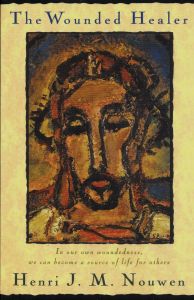
Scan0001Henri Nouwen, in The Wounder Healer, quotes James Hillman, who talks about the Jewish mystical doctrine of Tsimtsum, noting that

God as omnipresent and omnipotent was everywhere. He filled the universe with his Being. How then could the creation come about? … God had to create by withdrawal; He created the not-Him, the other, by self-concentration … On the human level, withdrawal of myself aids the other to come into being.

Nouwen elaborates:

when we have found the anchor places for our lives in our own center, we can be free to let others enter into the space created for them and allow them to dance their own dance, sing their own song and speak their own language without fear. Then our presence is no longer threatening and demanding but inviting and liberating.