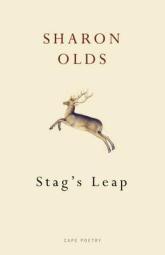
 Stag’s Leap by Sharon Olds is a book of poetry, written after her husband had left her for another woman. I picked this up the other day because (a) I needed something to read over lunch, (b) the subject matter intrigued me, (c) the blurb had succeeded in deepening my interest, (d) the book has won the T. S. Eliot Prize 2012 and (e) I felt like buying a poetry book (I actually bought two as it happens, but that’s a story for another day). Olds’s book also reminded me of Anne Carson’s The Beauty of the Husband, which similarly won the T. S. Eliot Prize, deals with the loss of a husband, is published by Cape Poetry and which I had enjoyed.
Stag’s Leap then. This is a sequence of poems (though not quite a narrative poem in the sense of Carson’s Autobiography of Red) divided into six parts – January–December, Winter, Spring, Summer, Fall, Years Later – in which Olds reflects on love, the body, sex, loss, betrayal, divorce, pain, grief, anger, hatred ….
There are many poignant moments in these poems, but the earlier reflections in ‘January–December’ and ‘Winter’ moved me the most.
Now I come back to look at love
in a new way, now that I know I’m not
standing in its light. …I am not here – to stand in his thirty-year
sight, and not in love’s sight,
I feel an invisibility
In the absence of love, Olds reflects, all that remains is ‘courtesy and horror’.
And yet, despite the horror and the pain, there are admirable expressions of tenderness and love even at the moment of separation:
In the last minute of our marriage, I looked into
his eyes. All that day until then, I had been
comforting him, for the shock he was in
at his pain – the act of leaving me
took him back, to his own early
losses. But now it was time to go beyond
comfort, to part. …
Olds finds it possible to think back on how blessed her life had been, partly because she had been able to love and had not lost her husband while he still loved her.
Here is another surprising and rather touching revelation:
… When anyone escapes, my heart
leaps up. Even when it’s I who am escaped from,
I am half on the side of the leaver. …
The poems talk about Olds’s shame at having been left by the one who knew her best. She notes how every hour is a ‘room of shame’ but also how there’s a ‘being of sheer hate’ inside her and how, since it cannot harm him, she can wound him, in her dream.
And she reflects on having lived with an idea, an illusion of her former husband, whom she did not truly see or know.
‘Years later’, she says:
… Maybe I’m half over who he
was, but not who I thought he was, and not
over the wound, sudden deathblow
as if out of nowhere, though it came from the core
of our life together. …
Even so, she can’t let go of him yet but holds him on a string, watching her idea of him pull away yet stay, her ‘silver kite’.
These poems poignantly express the conflicting emotions experienced in the wake of betrayal and loss.
 Brief thoughts & quotes …