
Spirituality

About a changing universe, real relationships and avoiding the will to power

Looking for something else, I stumbled across some quotes I copied from Wm. Paul Young’s The Shack some time ago. This book had a profound impact upon me at a time of the most intense inner turmoil. Rereading the extracts many months later, I was once again touched by the deep wisdom found in these lines.

On forgiveness and kindness:

Every time you forgive, the universe changes; every time you reach out and touch a heart or a life, the world changes; with every kindness and service, seen or unseen, [God’s] purposes are accomplished and nothing will ever be the same again.

And again on forgiveness, but also on relationships and how forgiveness, while important, is not the whole story:

Unless people speak the truth about what they have done and change their mind and behavior, a relationship of trust is not possible. When you forgive someone you certainly release them from judgment, but without true change, no real relationship can be established.

The next thought follows on from the previous reference to change:

Growth means change and change involves risk, stepping from the known to the unknown.

Some further reflections on relationships – and the problem of power:

Each relationship between two persons is absolutely unique. That is why you cannot love two people the same. It simply is not possible. You love each person differently because of who they are and the uniqueness that they draw out of you. And the more you know another, the richer the colors of that relationship.

Relationships are never about power, and one way to avoid the will to power is to choose to limit oneself – to serve.

And, moving on to different issues, some interesting observations on law, control, superiority and certainty:

Trying to keep the law is actually a declaration of independence, a way of keeping control. … [The law] grants you the power to judge others and feel superior to them. You believe you are living to a higher standard than those you judge. Enforcing rules, especially in its more subtle expressions like responsibility and expectation, is a vain attempt to create certainty out of uncertainty. And contrary to what you might think, [God has] a great fondness for uncertainty. Rules cannot bring freedom; they only have the power to accuse.
Spirituality

Divine love is incessantly restless

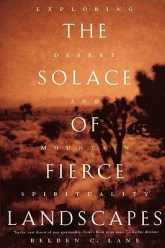
Some quotes from Belden Lane’s The Solace of Fierce Landscapes to complement my previous post:

The starting point for many things is grief, at the place where endings seem so absolute.

Divine love is incessantly restless until it turns all woundedness into health, all deformity into beauty, all embarrassment into laughter. In biblical faith, brokenness is never celebrated as an end in itself.

God can only be met in emptiness, by those who come in love, abandoning all effort to control …

… tragedy in one’s personal life can be trusted as a gift of God’s unfailing presence far more than trances, raptures, or visions received in so-called mystical experiences.

Referring to Moses’ and Elijah’s experience of God, Lane comments:

In both cases, their ‘seeing’ of God on the mountain was but an interlude in an ongoing struggle, given at a time when the absence of God seemed for them most painfully real. Transfiguration is a hidden, apocalyptic event, offering to those facing anguish a brief glimpse of glory to come. It incorporates a theology of hope into a theology of abandonment and loss.

Best Reads 2013 · Spirituality

Best Reads 2013. III: Belden C. Lane, The Solace of Fierce Landscapes: Exploring Desert and Mountain Spirituality

Belden C. Lane, The Solace of Fierce Landscapes: Exploring Desert and Mountain SpiritualityThe Solace of Fierce Landscapes, says Frances Young in Brokenness and Blessing, is the kind of book she would have liked to have written herself. Published by Oxford University Press, this is a well-informed exploration of desert spirituality. But it offers more than that. Talking about ‘the permeable boundaries between critical scholarship and lived experience’, Belden Lane also reflects on his own experience of spending time in wilderness places; and he gives a very personal account of his journey alongside his dying mother’s struggle with Alzheimer’s and cancer as well as his attempt to come to terms with his father’s somewhat mysterious death earlier on in his life.

The book is in three parts, which reflect the traditional three stages of the spiritual life: Purgation: Emptiness in a Geography of Abandonment; Illumination: Waiting in a Silence Beyond Language; and Union: Love as the Fruit of Indifference. These three stages, notes Lane, are symbolised by the desert, the mountain and the cloud.

There are chapters on:

  • spirituality and the environment,
  • wild terrain and the spiritual life,
  • prayer without language in the mystical tradition,
  • the symbolism of Mounts Sinai and Tabor in the Christian tradition,
  • the landscape and theology of early Christian monasticism,
  • the desert Christians’ counter-cultural spirituality of attentiveness, indifference and love.

And, to give you another list, which is the only way I can even begin to do justice to the book’s richness without giving an extensively long account, Lane offers insightful thoughts on:

  • abandonment of control (and the desert as teacher of renunciation and abandonment),
  • letting go and the emptying of self,
  • loving that which cannot be understood,
  • the power of compassion as the fruit of indifference (the notion of indifference might require some explanation, but you have to read Lane for that),
  • a new harmony with the land,
  • learning to pay attention,
  • the transformation of desire into love,
  • meeting love in the most unlikely places,
  • the power of silence to connect and heal,
  • liturgy and the reaffirmation of ordinariness.

Woven into the fabric of the book are interludes, called ‘mythic landscapes’, in which Lane takes his personal account of the journey with his dying mother as well as his repeated experiences of wilderness places as the starting point for further reflections on issues such as a spirituality of brokenness, the gift of nothingness in a desert landscape, the unexpected gifts of grief, and a spirituality of desire.

Having had some recent desert experiences myself, I have found this a rich and rewarding read.