Poetry · Spirituality

Stay bewildered inside God

Here’s a slightly longer excerpt from another Rumi poem, ‘The Basket of Fresh Bread’ (published in The Book of Love: Poems of Ecstasy and Longing). Some of Rumi’s poetry, which I discovered only recently, resonates very deeply with me and reinforces my journey into silence and contemplation.

Don’t look for it outside yourself.
You are the source of milk. Don’t milk others!

There is a fountain inside you.
Don’t walk around with an empty bucket.

You have a channel into the ocean,
yet you ask for water from a little pool.

There is a basket of fresh bread on your head,
yet you go door to door asking for crusts.

Knock on the inner door, no other.
Sloshing knee-deep in fresh riverwater,
yet you keep asking for other people’s waterbags.

Water is everywhere around you, but you see
only barriers that keep you from water.

Mad with thirst, you can’t drink from the stream
running close by your face. You are like a pearl
on the deep bottom wondering inside the shell,
Where’s the ocean?

Stay bewildered inside God,
and only that.

I love the imagery of nourishment and refreshment: water, milk and bread. Nothing spectacular, just staples, the stuff of everyday life, but essential. ‘Staying bewildered inside God’, that’s such an appropriate description of where I have been finding myself for some time now.
Poetry · Spirituality

Rumi on love

Look inside and find where a person
loves from. That’s the reality,
not what they say.

… and remember, the way
you make love is the way God will be with you.

If you want
to be more alive, love
is the truest health.

Lovers don’t finally meet somewhere.
They’re in each other all along.

Rumi, The Book of Love: Poems of Ecstasy and Longing

Poetry

Like mountain water

Speaking of poetry, here are some further thoughts, this time from Rumi, the Sufi master:

… Poetry, the dear

words and images of song, comes down
over me like mountain water

(Rumi, The Book of Love: Poems of Ecstasy and Longing)

Refreshing, live-giving mountain water, some poetry is indeed like that.

I also read recently that you come away from reading poetry, feeling that you have been cleansed – yet another image that I can relate to.

Poetry

A pointer to pure being

Having enjoyed poetry when I went to school, I somehow never followed this up, until fairly recently, inspired by a friend, I took to reading it on a regular basis. Now there is always some poetry on my book pile, and I would not want to be without it anymore. So what difference has it made?

It does, of course, depend on the poet I’m reading, but poetry lifts my spirit, it frees me and opens me up, it provides me with consolation and keeps my desire aflame. And it gives me a voice where, in the past, my pain and grief had been mute.

Most importantly perhaps, poetry, as Coleman Barks notes (in Rumi, Bridge to the Soul: Journeys Into the Music and Silence of the Heart), points me to pure being and persuades me there. What better place to be?

Best Reads 2013 · Poetry

Best Reads 2013. V: Anne Carson, Antigonick

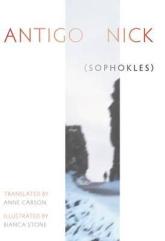
Anne Carson, AntigonickThis is Anne Carson’s translation (and adaptation) of Sophocles’ play Antigone. Following on from Nox, an epitaph written on the occasion of her brother’s death, Carson here revisits the theme of mourning a lost brother, for the heroine of Sophocles’ play is condemned to nothing less than a living death in a sealed cave, all because she wished to bury her dead brother.

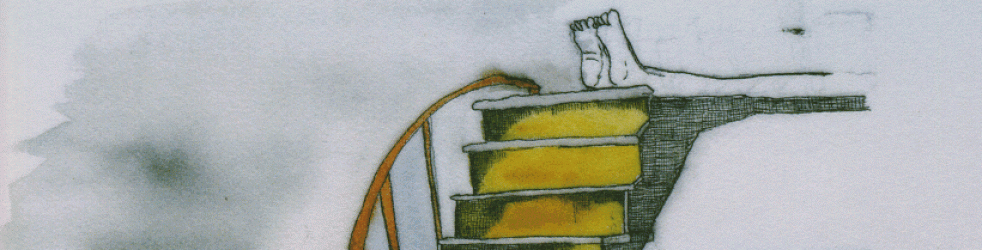
Anne Carson, AntigonickAntigonick is a powerfully compelling work, beautifully executed while at the same time, in typical Anne Carson fashion, bordering on the incomprehensible. The text is presented in handwriting (apparently Carson’s own), in capital letters and with hardly any punctuation. It is interlaced with rather surreal illustrations by Bianca Stone, printed on transparent vellum that overlays the text. It is not always clear how the illustrations relate to the text, but they contribute significantly to the beauty and appeal of the book as well as to its overall impact by heightening the absurdity of the world that Carson’s rereading presents.

Anne Carson, Antigonick
Illustration by Bianca Stone

Not an easy read this, but a fascinating one. Like Nox, it left me intrigued and deeply touched by Carson’s creative and harrowing ways of mourning her brother’s death.