Love dares the self to leave itself behind, to enter into poverty.
Thus Anne Carson, in ‘Decreation: How Women Like Sappho, Marguerite Porete and Simone Weil Tell God’ (published in Decreation: Poetry, Essays, Opera)
{mostly on fiction, poetry, spirituality, biblical studies and theology}

Love dares the self to leave itself behind, to enter into poverty.
Thus Anne Carson, in ‘Decreation: How Women Like Sappho, Marguerite Porete and Simone Weil Tell God’ (published in Decreation: Poetry, Essays, Opera)
 I love word clouds. They can be very helpful in visualising the use of words in all kinds of texts. This one, created with Tagxedo, illustrates the frequency with which words occur on this blog.
My lover rises and plunges above me, not knowing
I have hidden myself in my heart, where I rock
and weep for what has been stolen, lost. Please.
It is like an earthquake and no one to tell.
From Carol Ann Duffy’s poem ‘Survivor’, published in The Other Country.
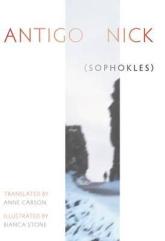 This is Anne Carson’s translation (and adaptation) of Sophocles’ play Antigone. Following on from Nox, an epitaph written on the occasion of her brother’s death, Carson here revisits the theme of mourning a lost brother, for the heroine of Sophocles’ play is condemned to nothing less than a living death in a sealed cave, all because she wished to bury her dead brother.
 Antigonick is a powerfully compelling work, beautifully executed while at the same time, in typical Anne Carson fashion, bordering on the incomprehensible. The text is presented in handwriting (apparently Carson’s own), in capital letters and with hardly any punctuation. It is interlaced with rather surreal illustrations by Bianca Stone, printed on transparent vellum that overlays the text. It is not always clear how the illustrations relate to the text, but they contribute significantly to the beauty and appeal of the book as well as to its overall impact by heightening the absurdity of the world that Carson’s rereading presents.

Not an easy read this, but a fascinating one. Like Nox, it left me intrigued and deeply touched by Carson’s creative and harrowing ways of mourning her brother’s death.
Hope is not logical, but a ‘participation in the very life of God’ (just like faith and love, which were called ‘theological virtues’ as opposed to virtues acquired by practice, temperament, or willpower). That doesn’t mean we should not practice being hopeful, but it is still not a matter of pure willpower. Faith, hope, and love are always somehow a gift – a cooperation with Someone Else, a participation in Something Larger than me.
The time is now, the forever now, for all of us to be engaged. To love fully, to be mindful, to care, to show up for this life.
Elizabeth Wurtzel, ‘The New C-Word’
I am hoping, in due course, to share some of the fruits of my engagement with Song of Songs 4:1-7 with readers of this blog. However, before I get on to that, I thought it interesting to address the question why we would want to read this book in the first place. It is, after all, quite an ancient text, which originates from a different time and culture and, being full of rather bizarre-looking metaphors, is not an easy read either. So why might we want to read the Song of Songs?
There won’t be any suggestions just yet. I am happy simply to pose the question for now, although I will be back with some thoughts.
 Brief thoughts & quotes …