Sometimes you come to an edge that just breaks off.
Anne Carson, ‘The Anthropology of Water’, in Plainwater: Essays and Poetry
.
{mostly on fiction, poetry, spirituality, biblical studies and theology}
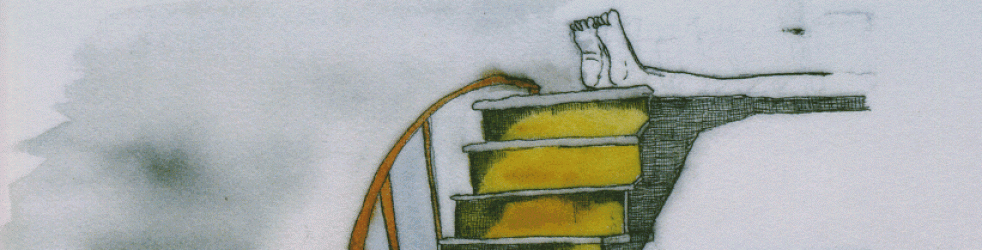
Sometimes you come to an edge that just breaks off.
Anne Carson, ‘The Anthropology of Water’, in Plainwater: Essays and Poetry
.
Do not hesitate to love and to love deeply. You might be afraid of the pain that deep love can cause. When those you love deeply reject you, leave you, or die, your heart will be broken. But that should not hold you back from loving deeply. The pain that comes from deep love makes your love ever more fruitful. … Every time you experience the pain of rejection, absence, or death, you are faced with a choice. You can become bitter and decide not to love again, or you can stand straight in your pain and let the soil on which you stand become richer and more able to give life to new seeds.
Henri J. M. Nouwen, The Inner Voice of Love: A Journey through Anguish to Freedom
 Joyce’s debut as a novelist tells the story of Harold Fry, a pensioner who, leaving the house one morning in order to post a letter to an old friend, ends up travelling all across England from Kingsbridge in the Southwest to Berwick in the Northeast. This is a book about an old man beginning to come to terms with his life, with mistakes made in the past and the ruins of a marriage that had been dead and loveless for a long time:
… for years they had been in a place where language had no significance.
There was no bridging the gap that lies between two human beings.
However, all this is slowly changing, for Harold’s pilgrimage leads to an awakening, as he becomes more fully aware of the world around him and develops a deep sense of compassion for the people he meets:
It was hard to understand a little and then walk away.
This is a gentle book with deep, yet unobtrusively expressed spiritual truths.
There were times, he saw, when not knowing was the biggest truth, and you had to stay with that.
Not knowing, or better yet, not understanding, indeed so often is the biggest truth and one that we need to learn to stay with, difficult though that can be.
In the process of setting up my new desktop PC I came across the wonderful ‘A Book of Sleep’ theme by Il Sung Na, which now graces my desktop. I also discovered this delightful video. Yes, it’s a children’s story, but so what! There’s nothing wrong with being young at heart, is there?
You have to watch this more than once. There’s more going on in this story than at first meets the eye. Oh, and in case you’re wondering, the desktop theme is available here.
Again from Germaine Greer, The Female Eunuch:
Loneliness is never more cruel than when it is felt in close propinquity with someone who has ceased to communicate.
… lovers who are free to change remain interesting.
.
Security is when everything is settled, when nothing can happen to you; security is the denial of life.
Germaine Greer, The Female Eunuch
Apparently, Rumi is the most widely read poet in America today. Why then does WordPress’s spell checker not recognise him?
Anyway, Rumi’s success is no mean feat for a writer who, after all, represents quite a different time, culture and religion. To be sure, his popularity has been made possible to a very large extent by the work of Coleman Barks, whose translation and adaption of Rumi’s poetry has given it a wide appeal that more literal renderings would never have achieved. True, something important may well have been lost in the process, as has been pointed out by those who charge Barks with Americanising this thirteenth-century Sufi poet. Yet something very important has also been gained, for amidst all the Islamophobia that sadly has gained such a strong foothold in parts of the Western world, there is now an increasing number of people who, thanks to Barks’s work, have encountered and learned to appreciate Rumi’s Sufist wisdom.
Does this not make both Rumi, the old master himself, and Coleman Barks, his modern disciple, ambassadors of peace?
 Brief thoughts & quotes …